Pages

mercredi 13 juin 2012

AMERICA'S CUP 1988 - STARS & STRIPES CATAMARAN - FIRST AMERICA'S CUP WINGSAIL - WINGSAIL - USA-1 CATAMARAN


A fault confessed is half redressed…

By ten days we have missed to commemorate the 24th anniversary of Stars & Stripes US-1 Catamaran! 
By Jacques Taglang and François Chevalier

Dennis Conner's 1988 catamaran Stars & Stripes US-1: Launched on May 24th 1988, christened on June 4th 1988 in San Diego... 24 years ago !


©François Chevalier


1988 STARS & STRIPES US-1 CATAMARAN


“The boats to be very big, very radical, and very controversial. The contest will not be a sailboat race. It will be a design lottery in which the sailors will have little or nothing to do with the outcome. In one word, the 1988 America’s Cup challenge will be bizarre.”

That was the assessment of Dennis Conner as published in an interview for the Australian review The Bulletin on December 15th, 1987. The facts would prove Conner right and the unsurprising victory of his small 18.30-metre LOA catamaran, Stars & Stripes, against the huge 27.43-metre LOA monohull New Zealand would remain forever the most incongruous America’s Cup. 


The long silence of the San Diego Yacht Club following Dennis Conner's victory with the 12-metre Stars & Stripes on February 4th, 1987 in Fremantle is often cited as the reason behind the 1988 America’s Cup. Taking literally the words of the Deed of Gift, the New Zealand banker Michael Fay, impatient with American foot-dragging, sent a challenge contrary to all expectations on July 15th, 1987.

His challenger would be a 90-foot monohull, pushing aside the 12-metre class that had been used in each Cup since 1958. Taken aback, the Americans rejected the challenge but Fay asked to the Supreme Court of the State of New York County to intervene. On November 25th, Justice Carmen Beauchamp Ciparick confirmed the validity of the challenge. 


©--


With just 10 months to prepare, the Defender decided upon a radical option. John Marshall, the chief of the Sail America Foundation design team, announced on January 22nd, 1988 that the defender would be a catamaran. The Americans had only eight months left to conceive, build and test a defender capable of repelling the assault of Fay's ‘Big Boat’.

The American decision was simple on one level, yet at the same time was complex. It was obvious that the multihull choice was likely to be interpreted as a provocation and would generate a new legal conflict. But from a sailing point of view it was simple – the Americans didn’t have the time to catch up in conceiving and constructing a big monohull. Instead, it was easier to opt for a catamaran, which was sure to be faster, more elusive, and with a LOA limited to 60 feet (18.29 metres) it would be able to be built quickly. 


©Dan Nerney 1988

On April 15th, 1988 (the immense monohull New Zealand had been sailing in the waters off Auckland since March 27th) John Marshall confirmed that two catamarans were in the process of being built. The first one would be fitted with a soft rig, the second with a hard rig. Conceived in record time, Stars and Stripes, the Defender catamaran was a successful marriage merging cutting-edge naval architecture with aeronautics. For this, Marshall co-ordinated a team comprising exceptional people like Gino Morrelli, who since his youth was fascinated by multihulls. He very quickly became one of the best American specialists and accepted without hesitation the challenge of the America’s Cup. With Bruce Nelson, Britton Chance and Bernard Nivelt, he drew up the catamaran. 

As expected, two 60-foot boats were built, one of them soft-rigged, following Morrelli’s design. The other one was hard-rigged with a winged-mast, a specialty of Dave Hubbard and Duncan MacLane (who had previously worked out this mode of propulsion on 25 feet-catamarans - 7.72 metre) belonging to the C-Class, as the famous Patient Lady. 


To scale up the concept of a mast-wing with articulated flaps from a 25-foot catamaran to a 60-foot machine, Marshall appealed to Burt Rutan's talents, the designer of Voyager, an ultra-light airplane that would make a round the world flight without stopping in 1988. In ten weeks, Rutan, Hubbard and MacLane, supported by a team of 40 people, succeeded in extrapolating the concept. It was an achievement “more difficult than with the airplane wing” Rutan would say later, because of the absolute constraint to save weight. 


©Marshall Harrington
On May 24th, the first boat was launched and in June, Dennis Conner sailed with the hard-rigged cat. The team discovered that in light wind, the traditional soft rigging of the sister ship was more effective. But in more steady, stronger winds, the hard-rigged cat was faster but the risk of material failure was bigger. So Rutan and his team built up a new winged mast and delivered it at the beginning of August. This second structure was 40% bigger and far more solid than the first one. The mast measured 32.61 metres, 5.80 metres more than the first one, and thus the performance was there: the catamaran fitted with the hard rig was preferred to the classic soft-rigged boat. 


©Marshall Harrington


Meanwhile, on May 5th, 1988, as expected, Michael Fay again asked for justice. He argued that the San Diego YC should defend the America’s Cup in September 1988 but with a 90-foot monohull. He noted the Deed of Gift required a match between “like and similar boats.” 


On July 25th, 1988 Justice Ciparick declared Fay’s argument premature and concluded: “The time has come for the sailors to be permitted to participate in the America’s Cup. The parties are directed to proceed with the races and to reserve their protests, if any, until after the completion of the America’s Cup races.” 

©Daniel Forster/Duomo


The "bizarre" 1988 Challenge eventually was sailed on September 7th and 9th off San Diego. It would be useless to hold forth on the ‘mismatch’ on the water. The Stripes & Stripes crew won easily. One matter was certain, this dramatic turn of events put an end to the 12-metre era and opened the way for the present International America’s Cup Class boats. 


The courts would rule again on the 1988 match, firstly on March 28th, 1989 to award the Cup to the New Zealanders and then on appeal to confirm the Stars & Stripes victory. Some months after the race, a Mexican yachtsman, Victor Tapia, acquired the catamaran. Excited by the prospect of watching the 1992 America’s Cup races, Tapia sailed the cat to San Diego. Ten years later, Stars & Stripes was sailing on Valle de Bravo Lake, near Mexico City. The last report we had of it, Stars & Stripes was for sale in Mexico. 


©--
The fate of its sister ship with the conventional soft rig, Stars and Stripes (S1 version) was more spectacular than the 1988 Defender (H3 version). Steve Fossett, the man with dozens of speed records, acquired it in the 1990s.

©Sail America Foundation

Fossett demonstrated that Stars and Stripes still remained among the fastest multihulls of its generation. To this day, it holds, among others, the record for the Mackinac race, sailed on Lake Michigan between Chicago and Mackinac. On the occasion of the 100th Mackinac Race raced on July 18th and 19th, 1998, Stars and Stripes sailed the distance in 18 hours, 50 minutes, and 32 seconds. Since the year 2000, this Stars & Stripes is owned by a yachtsman from Naples, Florida, Mark Reece.


STARS & STRIPES US-1 

Catamaran defender 
1988 

Sail number: US-1 

Code number of the winged catamaran: H3 
USA 


Yacht club: San Diego Yacht Club, San Diego, California, USA 

Successful defender of the 27th 1988 America’s Cup Challenge 

Owner: Sail America Foundation, Inc. President and chief executive officer: Malin Burnham. Stars & Stripes Team, management/administration: Dennis W. Conner 


60 foot wing-sail catamaran 


Design team: John K. Marshall (coordinator), Bruce Nelson, Dave W. Hubbard, Duncan T. MacLane, Gino J. Morelli, Britton Chance, Jr., Bernard Nivelt. 


Wing designers: John Roncz and David Lednicer

Builders 

- Hulls: RD Boatworks, at Capistrano Beach, California 

- Wings: Scaled Composites, Inc., at Mojave, California 


Christened: 4 June 1988 at San Diego 


Year of building: 1988 

Launched: May 1988 

Homeport: San Diego. 


Skipper: Dennis Conner 

Crew: Louis B. Banks, John Barnitt, Carl Buchan, John Grant, Peter Isler, Cam Lewis, Duncan MacLane, Randy Smith, Bill Trenkle, John Wake, Thomas Whidden. 


Data: 


Construction – 


- Hulls: Carbon fiber-Nomex sandwich 

- Masts: Carbon fiber-Nomex sandwich 

- Wing sail: Carbon fiber, covered by Mylar and Dacron 


Dimensions – 


L.O.A.: 18.28 m 

L.W.L.: 16.76 m 

Beam: 9.14 m 

WL beam: 8.90 m
Draft: 3.04 m (with dagger boards down) 

Wing Area: 176.50 m2 (upwind) 

Total sail and wing area downwind: 405 m2 
Displacement: 2.950 tons 

Main wing height (air draft): 32.61 m 


Two wing-sails were built. The biggest one was fitted for racing the Cup. The smallest one had one flap less (air draft: about 27 m).

Observations – 


1988
Two catamarans were built. The first one with a soft sails (conventional), code number S1, the second one with a winged rig. It was this last one that race the 1988 America’s Cup. 


The 1988 America’s Cup races: 7 to 9 September 1988 off San Diego, California. 
Best two out of three races. 


Stars & Stripes raced against the huge 90 feet mono-hull challenger New Zealand KZ-1 

Races: two sailed. 


Race Course: 
Alternate courses 

First race 40 nautical miles long, one windward leg (20 miles) and return. 

Second race 39 nautical miles, triangular course (13 miles by leg, first windward, two and three reaching leg). 


Results: 

Stars & Stripes beat New Zealand KZ-1 by two wins to nil! 


- 7 September 1988, 1st race. Wind speed: 7 to 9 knots. Stars & Stripes beat New Zealand by 18 minutes and 15 sec. 


- 9 September 1988, 2nd race. Wind speed: 6 to 15 knots. Stars & Stripes beat New Zealand by 21 minutes and 10 sec. 


As wrote Tom Coat, the 1988 America’s Cup was “a Cup of controversy”, but it was also, in the spirit of the tradition of this event, a fantastic technical challenge on both sides. 


1989
Stars & Stripes was sold and moved to Mexico. Victor Tapia owned it. 


1992
Victor Tapia took Stars & Stripes to San Diego for the 1992 America’s Cup Challenge, and used it as a charter boat. He also raced the boat in California during that time. 


2002Stars & Stripes was an attraction for a deluxe hotel in Mexico, the Menson del Viento. Its homeport is Valle de Bravo, Mexico. 


2005 
Still in Mexico, Stars & Stripes appears to be for sale…


On August 2009, Stars & Stripes was still at anchor in Mexico…

©François Chevalier 2012


lundi 11 juin 2012

AMERICA'S CUP - 34TH AMERICA'S CUP - SAN FRANCISCO - CATAMARAN - HISTORY - DUSTER

WHAT A PREMONITION!


One year after the launching of his catamaran Amaryllis (1876) - the first modern cat ever designed and built - Nathanael Greene Herreshoff designed John Gilpin (1877)...


©François Chevalier

©François Chevalier


In the same time, this little racing catamaran, Duster (1877), sailed by one person was cruising right past front of the San Francisco Yacht Club's club house. 


©University of California - Berkeley/Bancroft Library


135 years before the AC72 of the 2013 America's Cup first sails on the same stretch of water!

By Jacques Taglang

AMERICA'S CUP - HISTORY OF YACHT DESIGNS - TWIN-KEEL - YACHT DESIGN INNOVATION - FIN-KEEL - BALLAST

THE TWIN-KEEL, A HUNDRED YEAR-OLD DREAM

By Jacques Taglang & François Chevalier


In 1891 Dilemma was launched, the first true modern fin keel deserving of this name and with it, Nathanael Greene Herreshoff revolutionised the science of naval architecture. 
©François Chevalier 2012


By demonstrating the design could sail effectively, he freed the creative spirit of numerous designers and within a year his ‘invention’ had spread around the world.

©François Chevalier 2012


Dilemma also generated some audacious interpretations, which at the time appeared to be dead ends, including the twin-keel (fork or tandem keel). Who could have known that a century later, these very designs would be hidden under the skirts of several America’s Cup Class boats? 

1893: A first attempt at the ‘twin-keel’

Dilemma (1891) was one of the American designer Nathanael Greene Herreshoff’s most brilliant designs, and this is from a man who would model no less than six successful America’s Cup defenders. Dilemma sailed around the world and inspired some audacious copies including the enormous 1893 America’s Cup defender candidates, the 25.90 meter Jubilee and Pilgrim.


Jubilee - Sail Plan - ©François Chevalier


Pilgrim - Sail Plan 1893 - ©François Chevalier


However some particularly imaginative spirits also thought about further developing the fin keel. The English naval architect Linton Chorley Hope (1863-1920) proposed a curious system intended for a small sailboat which would allow for the lead bulb to be raised through two articulated metal fins. This system would allow the sailors to adjust the height of the ballast according to the wind. 

Jacques Taglang's Collection - The Yachtsman 1893


Linton Hope suggested even reducing or increasing the width of the fins, but at the time, fluid dynamics was in its infancy, and testing would have to wait. But by 1901 the Scottish naval architect George Lennox Watson would lead the pack when he made the first ‘towing tank’ tests with Sir Thomas Lipton’s America’s Cup challenger, Shamrock II and trialed his models with various heeling and course angles. 

1895: A surprising ‘trim tab’ twin-keel …

Three years after Dilemma, a surprising drawing was published in The Yachtsman magazine, showing a double keel formed by two fixed metal fins ballasted by a lead bulb. A sort of rudder (the ancestor of the trim tab?) was fitted between both fins of the keel. This surprising system was tested on a small dinghy.

Jacques Taglang's Collection - The Yachtsman 1895


The conclusion was interesting: “The boat’s worst point of sailing was her windward work, and she was much improved in this respect“ by the use of this ‘twin-keel’ with adjustable flaps. The boat, also fitted with an aft rudder, pointed very close to the wind and the stronger the wind, the better it performed, according to the authors of the comment that explained the drawings. 


1898: A frightening boat… 

Two years later, another drawing was published that elicited fear from observers. The drawing concerned a Sharpie type craft of 13 meter LOA, drawn by Captain Marony. Unfortunately, it would never be built. But most people conclude that this plan is the first twin-keel deserving of the name. Commentators at the time however, were not very enthusiastic.

Jacques Taglang's Collection - The Yachtsman 1898

"We do not mean to commit ourselves by offering any opinion as to her merits, but we would most decidedly hesitate to make a voyage in her from the Solent to the Clyde. We are afraid the crew would require more than the usual emolument if they were required to live on board. It would be very interesting to see such a craft competing with the present types, but, though the cost of construction would be small, we are afraid our wish will not be granted.” 

1992: The Little Red Skiff!

The America’s Cup, as history shows, is a laboratory for many things, and especially, yacht design and naval architecture. It is true that in the case of appendages (the keel, rudder, trim-tab) any changes have been long in coming. A glance at the record shows some remarkable developments, such as those of Jubilee and Pilgrim in 1893, of Intrepid in 1967, Olin J. Stephen’s drawing who created the trim tab and fitted a suspended and separate rudder, and of Australia II in 1983 with which Ben Lexcen dared to build the famous ‘inverted’ and winged keel. More recently there has been US 61 the Gary Mull design that had this twelve meter boat with two rudders, one being fitted just aft of the bow. Tom Blackaller would sail this boat into the semi finals of the 1987 Louis Vuitton Cup in Fremantle. This configuration would be seen again five years later on Nippon JPN-26, skippered by Chris Dickson.

Then, in 1992, with the advent of the America’s Cup Class, imaginations were set free and in San Diego, no less than four competitors were fitted with a tandem or twin-keel with double rudders. The defence candidate Stars and Stripes USA-11 skippered by Dennis Conner, sailed with this before quickly switching to more classical configuration. 

©Sally Samins


One of Japanese challengers, Nippon was also fitted with a twin-keel while Iain Murray’s Spirit of Australia AUS-21 raced during the Louis Vuitton Cup Round Robins with a tandem keel. But the most surprising 1992 America’s Cup Class boat in San Diego was New Zealand NZL-20. Nicknamed the Little Red Skiff, NZL-20 was a Bruce Farr design. 


©--

©CupInfo.com


It was drawn up from the very beginning with a twin keel and was fitted with a small bowsprit. It was this small spar that would apparently cause the defeat of the Kiwis, following a protest by the Italians of Il Moro di Venezia ITA-25. On the verge of winning the Louis Vuitton Cup, the New Zealand team was seriously destabilised by the protest, and the Italians advanced to the America’s Cup. But that doesn’t detract from the speed and efficiency demonstrated by the Kiwi boat with its ‘twin-keel’.


Fatal attraction


Despite the eventual failure of the Kiwis in 1992, in 1995, it seems that the Australians led by John Bertrand tried a similar appendages configuration on oneAustralia AUS-29 or AUS-31. But a structural weakness would prove fatal for AUS-31, which broke up and sank in testing conditions. During the millennium America’s Cup in 2000, only the Swiss boat behAPpy SUI-59 used the curious appendages designed by Peter Van Oosanen, but it proved to be a very difficult boat to sail with an aft rudder ballasted with a lead bulb doubled by a fore-ballasted rudder or canard. Despite its difficulties, the boat showed remarkable speed on occasion. Then, in 2003, the British challenger candidates Wight Lightning GBR-70 and White Magic GBR-78 (Rob Humphrey, Stephen Jones, Tim Corben, Akihiro Kanai and Taro Takabashi designs) also tried the twin keel for a time, but it didn’t prove to be the magic bullet the team was hoping for and the GBR Challenge was eliminated in the quarterfinals of the Louis Vuitton Cup. 


mardi 5 juin 2012

RUNA - GERHARD RØNNE - RUNA'S SAGA - YVES CARCELLE - GREGORY RYAN - CLASSIC YACHTS

PASSION FOR BEAUTIFUL YACHTS: YVES CARCELLE'S RUNA IV

Have a look on this link: challenges.fr
(French text)


LA PASSION DES BEAUX YACHTS: LE RUNA IV D'YVES CARCELLE

Cliquer sur le lien : challenges.fr


©Nigel Pert 2011


AMERICA'S CUP - HISTORY OF THE MULTIHULLS - HISTOIRE DES MULTICOQUES - THE ANCESTORS of the AC72 - LES ANCÊTRES DE L'AC72


Nous avons décidé d'ouvrir le "livre" des origines... Celles de l'AC72 qui va bientôt disputer l'America's Cup en septembre 2013 à San Francisco. Cette suite sera pour nous l'occasion de vous présenter de façon chronologique ou non l'évolution des multicoques, de vous faire découvrir les curieuses inventions, abouties ou non, qui s'y réfèrent, de vous montrer l'incroyable et parfois folle imagination des marins.


Bonne lecture

François Chevalier & Jacques Taglang


LES ANCÊTRES DE L’AC72 – L’ORIGINE


par François Chevalier

Avant de traiter des machines qui sont en construction pour la prochaine América’s Cup, faisons un détour en remontant à l’origine de ces “bolides“ : Les pirogues Océaniennes. Catamarans, trimarans ou praos, elles étaient déjà qualifiées par Pigafetta, en 1521, lors du premier tour du monde à la voile par Magellan, d’objets volants !


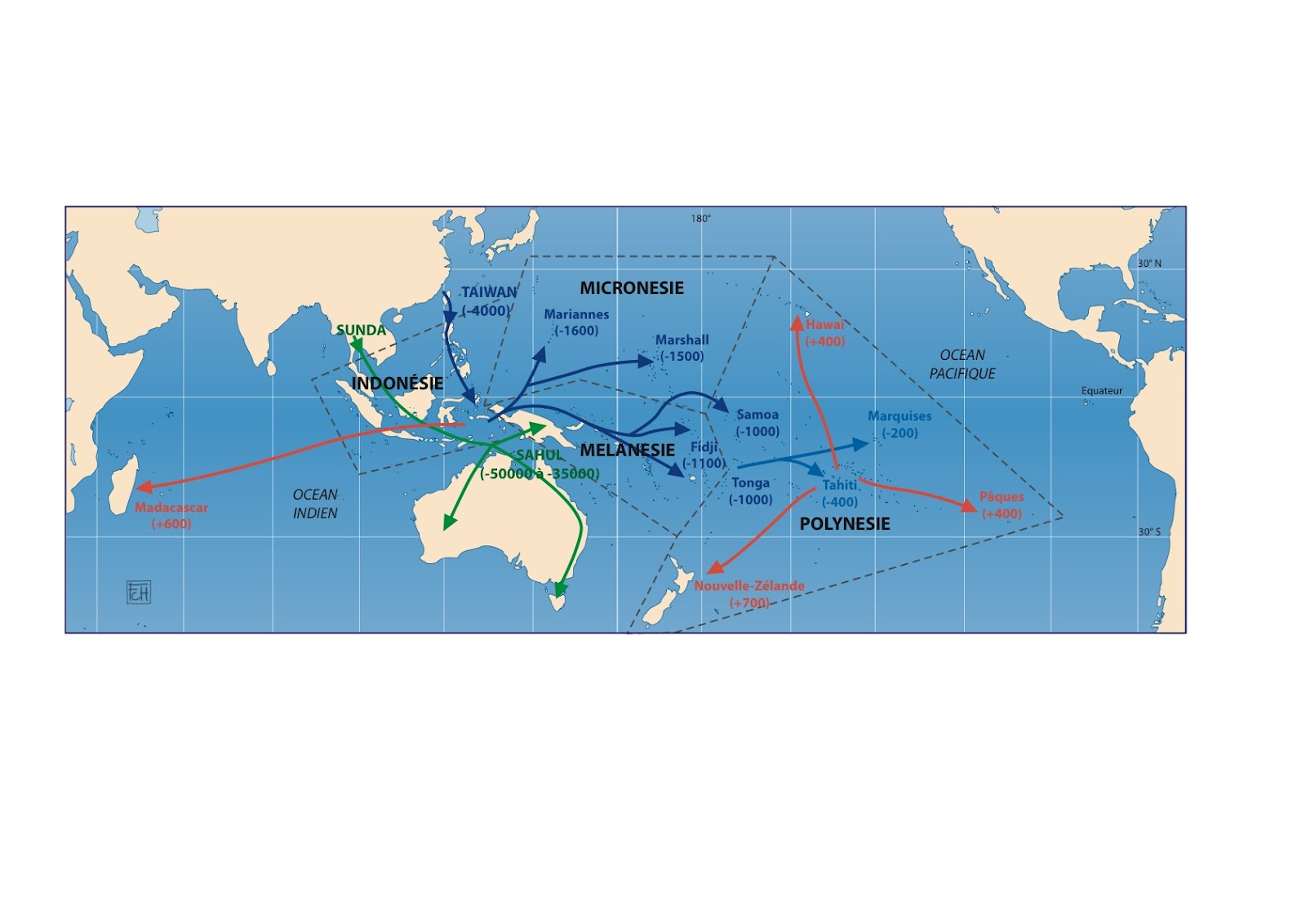
Pour comprendre l’évolution de ces engins volants et leur répartition géographique, de l’Océan Indien aux rives de l’Amérique, je propose de jeter un œil sur la carte du peuplement de l’ensemble de ces îles.


Le mouvement migratoire s'est effectué en plusieurs étapes successives s'étalant sur plus de 50 000 ans.
La première vague de peuplement de l’Indonésie, de la Nouvelle Guinée et de l’Australie a lieu lors de la dernière glaciation. En effet, les peuples Sunda et Sahul  profitent de la baisse du niveau de la mer de 150 mètres pour progresser vers l’Est et le Sud, entre 50 000 à 35 000 avant notre ère (en vert sur la carte).

Puis vers l'an 4000 avant JC, des peuples venues par la mer de Taïwan se mêlent aux précédents. À partir de 1600 avant JC, cette population se disperse en Micronésie (îles Mariannes, Marshall…) puis en Mélanésie jusqu'en Polynésie occidentale (Fidji, Tonga, Samoa) vers l'an 1000 avant JC (en bleu sur la carte).

Il faudra attendre cinq siècles pour que les polynésiens reprennent leurs migrations vers Tahiti et les Marquises. À partir de ces archipels, une nouvelle vague de migration débute, on estime ainsi le peuplement des îles Hawaii et l'île de Pâques aux alentours de l'an 400 après JC. La migration à travers l’Océan Indien touche Madagascar et les îles alentour vers l’an 600 alors que la Nouvelle-Zélande est atteinte autour de 700 après JC (en orange sur la carte).

Dès les premiers tours du monde, les explorateurs ont été subjugués par la vitesse des embarcations rencontrées dans le Pacifique.

Si Pigafetta ne s’attarde pas à une description détaillée des pirogues rencontrées aux îles des Larrons (Iles Mariannes), Thomas Cavendish en 1588 est impressionné par leur nombre. En 1616, Jacob Le Maire décrit un catamaran des Iles Tonga de façon assez pittoresque. Puis Dampier, en 1686 en mesure la vitesse, en affirmant "que ces pirogues sont les bateaux les plus rapides du monde, établissant des moyennes de 18 nœuds sur plusieurs centaines de milles." 


Alors que William Funnell croise les îles du Pacifique en 1705, il exécute un croquis bien fantaisiste d’un “flying prao“, Woodes Rogers en rapporte un démonté, six ans plus tard, à Londres, où l’engin est exposé au Park Saint James. Le premier relevé digne de ce nom, (reproduit ici) mais rempli d’erreurs, est exécuté par Mr Brett lors du voyage autour du monde d’Anson, en 1742. Il est en effet extrêmement difficile pour un occidental de comprendre le fonctionnement de ces voiliers. Pour couvrir le sujet dans sa totalité, il faudra attendre la publication des travaux de l’Amiral Paris (1839), de ceux de James Hornell en 1936 et de Jean Neyret (publiés entre 1959 et 1976).

À travers six exemples de pirogues Océanienne, nous allons voir la richesse, la diversité et l’inventivité de ces peuples de la mer.

En tout premier lieu, nous observerons celles qui ont été découvertes en premier par les explorateurs du Pacifique, les praos des îles des Larrons, connues sous le nom des îles Mariannes, à mille milles au Nord de la Nouvelle-Guinée. 

L’exemple choisi est celui du relevé de Mr Brett, d’une douzaine de mètres de long, qui est constitué d’une coque formée d’un tronc creusé, de deux planches latérales cousues, et de deux étraves symétriques, également cousues. Le mât est maintenu par un contrefort qui prend appui sur les raidisseurs des bras du flotteur au vent, et tenu par un étai fixé au même endroit. Lors des virements de bord, la voile est déplacée d’avant en arrière en balançant le mât, et la pagaie sur l’autre étrave devient gouvernail. La coque pouvait être composée de plusieurs morceaux et des planches latérales superposées ; une plateforme sur les bras et une autre en travers pouvait aussi compléter le voilier en fonction de son programme de navigation. On remarque la dissymétrie des coques, favorable à une meilleure remontée au vent, le flotteur était maintenu par deux piquets enfoncé dans chaque bras, tendus par des cordages croisés. L’amiral Anson précise que ces pirogues "sont capables de serrer le vent de beaucoup plus près que tout autre navire connu", remarque étonnante pour des voiliers qui datent de plus de 3000 ans !

La variété des gréements des voiliers de l’Archipel de Bismarck et de celui des Louisiades, illustrée ici par deux grands praos, montre les influences indonésiennes. 

On retrouve ce genre de voile sur des sculptures très anciennes sur l’île de Java. Sans vouloir faire de polémique sur l’invention de la voile rigide, celles-ci étaient faites de feuilles tressées, donc assez rigide, et l’ensemble pouvait être balancé autour de son point d’attache en haut des mâts, en fonction de la meilleure prise au vent suivant l’allure et la force du vent. 

De 10 à 15 mètres, ces praos existaient aussi en grande dimension, de 18 à 25 mètres, pour les longs voyage ou les cérémonies. On peut remarquer la même disposition sur le maintien des mâts, tenus par des arc-boutants et tendus par un étai au vent. Le détail du plan de la coque d’un "Lia-No" des Louisiades, montre des fargues à clins qui protègent la coque des embruns, et les sections idéales de la carène, en demi-cercle, réalisant ainsi un modèle parfait de réduction de la surface mouillée.

Le peuplement des îles Fidji advient à la suite de celui des chapelets d’îles qui prolongent la Nouvelle-Guinée à l’Est. 

Le catamaran présenté ici est constitué de deux pirogues assemblées. Elles peuvent, une fois démontées, recevoir leur balancier respectif. Chaque coque est constituée d’un ou plusieurs troncs creusés, suivant la longueur de la pirogue, entre 12 et 24 mètres, rehaussés par des éléments habilement ajustés et cousus. Les deux coques sont disposées en quinconce. À l’image de nos multicoques modernes, les étraves sont verticales. Sur les catamarans de grande taille, l’espace entre les coques était recouvert d’un pont. Le voilier est dirigé par deux gouvernails, un sur chaque coque, placé sous le vent. La voilure triangulaire est posée sur la coque sous le vent, l’autre sert de balancier. Pour virer de bord, la voile est carguée sur la vergue haute, le mât légèrement relevé et la voilure portée sur l’autre côté.

Les catamarans des îles Tonga ont été largement illustrés par les premiers explorateurs, en particulier Schouten, Tasman et Cook. Lescallier en a relevé les plans dans son "Traité pratique du gréement des vaisseaux", mais plusieurs détails leur ont échappé. 

De grande taille, de 15 à 25 mètres, ces navires recevaient jusqu’à 150 passagers, et embarquaient une petite pirogue en guise d’annexe. On sait qu’ils se rendaient en Mélanésie et en Micronésie. La plateforme est posée sur des fargues et quelques supports étayés. Deux longues écoutilles permettent d’accéder au fond des coques et d’écoper l’eau qui ne manque pas d’envahir les fonds dès que la mer est formée ou que le voilier avance à grande vitesse. Généralement, le pont est équipé d’une hutte demi-circulaire et d’un foyer sur l’avant, au pied du mât, pour la cuisine. Le mât est assez court, muni d’une fourche ; il est maintenu par deux outriggers latéraux rappelant le gréement de nos 60’Open à mât aile. Pour de courts louvoyages, la voile vient naturellement contre le mât, comme sur les voiles latines, "à la mauvaise main", mais pour des bords prolongés, le mât bascule à la verticale afin de faire passer la voile sous le vent. Les deux avirons sont toujours positionnés sous le vent.

Enfin, le dernier exemple de ces antiques embarcations est un trimaran que l’on trouve sur les cotes Africaines, aux Comores ou à Madagascar. 

Celui-ci a été relevé à Zanzibar au début du XX siècle. Si la voile à bordure libre est d’inspiration arabe, la conception du voilier est issue de l’Indonésie. Cette pirogue à double balancier est équipée de flotteurs dont les fonds plats sont inclinés vers l’extérieur, faisant office de ski nautique et de foils. La voile est maintenue sur un mât court, dans l’axe du bateau, et passe sur l’autre amure au louvoyage. D’une longueur de 7 à 9 mètres, ces engins rivaliseraient de vitesse avec nos modernes multicoques.

Tous ces "bâtiments légers," comme les dénomment nos ancêtres, embarquaient pas mal d’eau et un équipier était chargé d’écoper, que ce soit pendant la pêche ou en voyage. La vitesse était à ce prix !