Pages

dimanche 12 février 2023

Evolution of the Whitbread yachts' hull design, from 1974 to the Ocean Race 2023 - SECOND PART

1 - From the 1970s Maxi to the first W60

2 - From the Volvo 60 to the Volvo 70

3 - From Volvo 65 to IMOCA


SECOND PART:

From the Volvo 60 to the Volvo 70

 
-       EF Language Sail plan © F Chevalier

In the 1997-98 edition, the Whitbread Round The World Race was raced with the W60s, and the score was counted in points, instead of time added up over the nine legs. Ten contenders left Southampton for this round-the-world race, the last leg of which took place in La Rochelle. Bruce Farr signed 8 of the 10 designs, and took the first seven positions, and the ninth, with the female crew led by Christine Guillou. Paul Cayard, famous sailor, won on EF Language ahead of an impressive number of racing figures, such as Dennis Conner, Chris Dickson, Laurie Smith, Grant Dalton, Ross Field or John Kostecki. The Farr designs were all very similar, with shapes which were still quite round in comparison to previous Maxis.

- EF Language Perspective © F Chevalier


The next Whitbread, which was sponsored by Volvo in 1997-98, changed its name to the 2001-02 Volvo Ocean Race. 

The new rules defining the VO 60s allowed carbon rigs, which boosted these sailboats and profoundly changed their performance. Of the eight contenders for victory, six designs by Farr Design raced. The Nautor Challenge team had two boats built, one by Bruce Farr, Amer Sport Two, the other, Amer Sport One, by German Frers, Jr., "Mani Frers ».Skipper Grant Dalton reserved his choice until the last minute, leaving Farr's yacht to Lisa McDonald women's crew. Finally, the eighth was the Norwegian Djuice Dragons, designed by Laurie Davidson.

What is particularly striking when watching the three designs, is the narrowness of the boat waterline on the one hand, and on the other hand, the rather pronounced hollow of the hulls. The three designers created narrow hulls, with the ballast as far outboard as possible, with a small rounded bilge at the main beam.

According to Farr, a boat has to be a "sled" shaped to match the requirements of the rule. The hull seems to be carved with a sword: the bow is carved in a sloping plane following a straight line from the bow to the mast. 
 Illbruck Challenge lines © F Chevalier

Then follows a second vertical section over 50 cm and parallel on each edge. This one runs far aft. Lastly, the ultimate cut occurs on the sides, at 45° towards the bottom of the keel at the point where the warp is measured. It goes on without trickery until the transom. 
Djuice Dragons lines © F Chevalier

Laurie Davidson has focused on safety and designed a high reserve buoyancy in the bow, penalized by a high surface area. Djuice's wing keel seems significant compared to the others.


Mani Frers' drawing shows a greater stiffness, with less flared sides than those of her competitors, and a more raking bow. 
Mani Frers' Amers Sport One lines © F Chevalier

Her fin-keel, slightly forward of the mast, helps to sail close-hauled, but makes the racer more flighty when sailing downwind. Her sail plan is very far back, with a mast close to the middle.

Farr's yachts won the first two places, Illbruck Challenge ahead of Assa Abloy, Mani Frers' design was on the final step of the podium. Laurie Davidson's racer settled for sixth', winning the last leg.
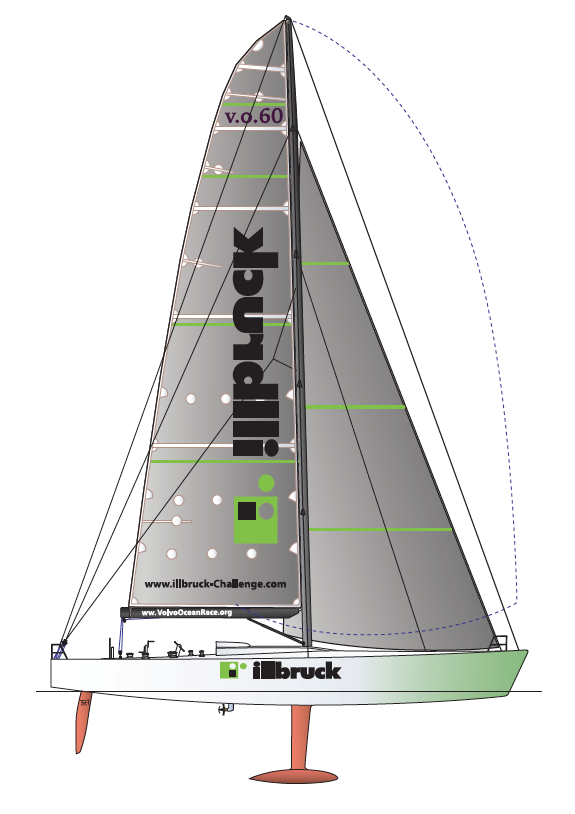
Illbruck Challenge © F Chevalier

A new class of yacht was launched for the 2005-06 Volvo Ocean Race, the Volvo Open 70. Longer, relatively lighter, more canvassed, with canting keels and two optional rudders, they have inherited the progress of the America's Cup like the TP52 or the Open 60. 

Juan Kouyoumdjian was the great champion of the race, his ABN Amro One won 16 of the 22 legs and his ABN Amro Two, skippered by Sébastien Josse, finished fourth, establishing a new speed record over the 24 hours. Bruce Farr's four VO 70s, Pirates of Caribbean, sailed by Paul Cayard, Brasil, Ericsson and Movistar came in between, and the Australian boat designed by Don Jones, Brunel-Sunergy, finished last.
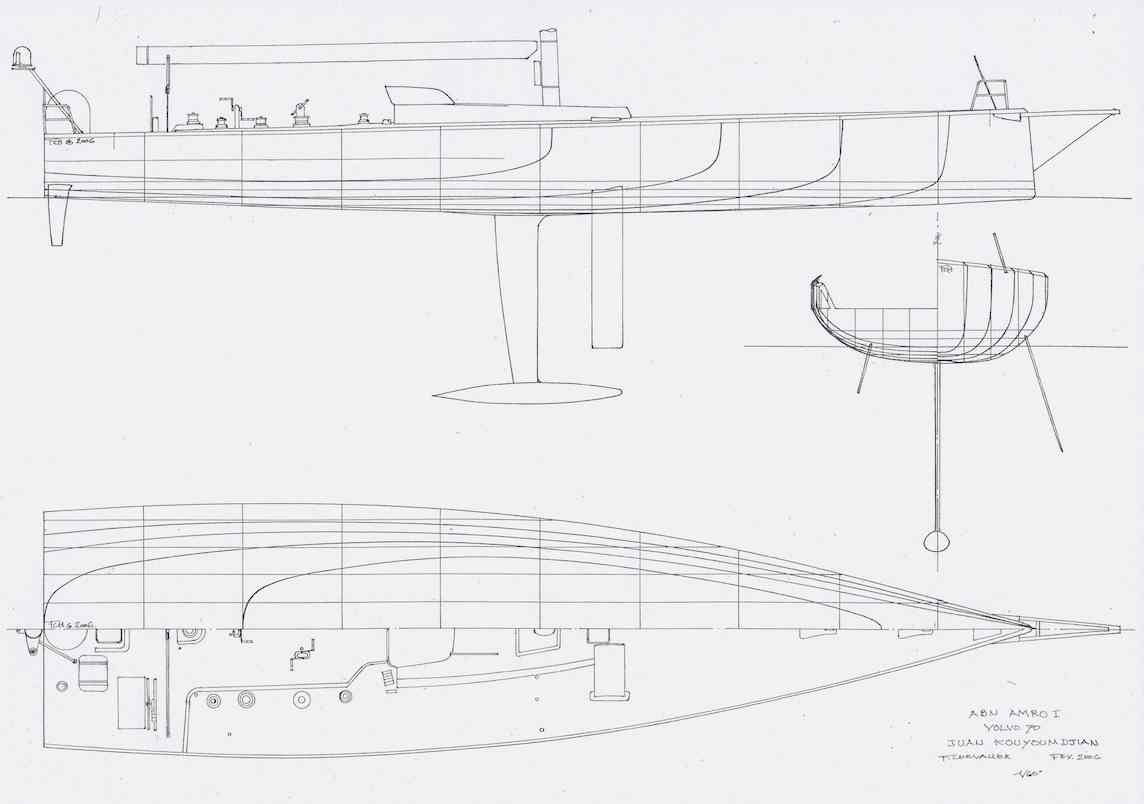
ABN Amor One's lines © F Chevalier

JK's designs take full advantage of the rule, wider and therefore stiffer, with an inverted and raking bow, a canted keel, rotating inside the hull, which increases the stiffness upwind, a streamlined hull on the aft half, a deep daggerboard, a protracted keel with a reduced section. More powerful and more planing, these hulls will make themselves felt and will influence the future hulls. 

Movistar's  lines © F Chevalier 

Bruce Farr searched for smoothness and balance, with a rudder in the centerline of the yacht. Movistar lost her keel, the crew was rescued by ABN Amro Two.

Brunel-Sunergy's lines  ©F Chevalier 

Meanwhile, poorly supported by a limited budget, Don Jones had developed a more conventional boat, rounder and wider, with full forward shapes, a single daggerboard forward of a very advanced mast, and a cockpit that was very far aft.

ABN Amro One Sail plan © F Chevalier


The tenth edition of this round-the-world race, the 2008-09 Volvo Ocean Race has become increasingly difficult for the public to follow. It started in Spain, passed through Cape Town, reached Singapore, then China in Qingdao, crossed the Pacific Ocean from North to South, reached Rio and Boston, Ireland, Gothenburg, Stockholm, and ended in St. Petersburg, Russia! We went a long way from the Whitbread in four legs.

Of the ten yachts, Juan Kouyoumdjian designed three, Bruce Farr two, Botin Carkeek one, Reichel/Pugh one, and Roy Humphreys the latest.

Ericsson 4, a JK'design, with Torben Grael at the helm, dominated the field, followed by Botin's Puma, sailed by Ken Read, with Farr's Telefonica Blue in third place. 

I did not have the possibility to finalize the drawings I had prepared for the 2008-2009 edition, as no magazine followed up on my proposal to publish the designs of the five design offices.


Ericsson 4 sail plan © F Chevalier

Among the three designers in the race for 2011-2012, Juan K imagines half of them, the French Groupama 4 helmed by Franck Cammas, the American Puma skippered by Ken Read, and the Spanish Telefonica, helmed by Iker Martinez. Farr Yacht Design drew one, Abu Dhabi; the Chinese Sanya was the former Telefonica Blue, a Farr design, skippered by the 2006 winner, Mike Sanderson. Finally, Marcelino Botin, remarkable for his TP52s, was the author of the Camper design for ETNZ.

Camper lines © F Chevalier

Perhaps most surprisingly for this "Box Rule", the designs of the three designers turned out totally different. Marcelino Botin created a real super TP52, narrow and stretched out to the extreme, with a very advanced center of gravity, a beam backed up three-quarters of her length and a low transom, huge daggerboards aft of the mast, itself centered on the middle of the sailing boat.

Abu Dhabi lines (Farr Yacht Design) © F Chevalier

Farr's design breaks with all trends. Considering that these racers plane from the slightest breeze, and stop abruptly in too steep waves, the hull needs to get up to speed as quickly as possible, and tilt close-hauled without pivoting too much on the bow, in order to increase the stiffness. The Result: a monumental bow, round and strong, grazing, vertical side walls, a maximum beam allowed halfway up the yacht, a wide and centered waterline, stretched but soft shapes, fine and elaborate daggerboards, practically vertical and close to the axis. The deck is curved towards the bow, without roof marking.

 Groupama 4 lines (by JK) ©F Chevalier

Juan K has evolved his earlier drawings, optimizing all the benefits already acquired in the last edition won by the Swede Ericsson. Very developed front shapes, clearly evident in the forward sections, under a bilge that goes all the way to the bow; flat bottoms starting from the bow, ensuring a planing start and spreading the axis of the boat when heeling to increase stiffness; back bottoms following the curve of the wave, favoring the continuation of the wake and lengthening the wave that determines the speed limit. All of these elements have proven their effectiveness over the other contenders.

Groupama 4 has won the Volvo trophy on the Botin Camper design, followed by the two new JK designs, Puma and Telefonica, with the two Farr's finishing dead last.
Groupama 4 Sail plan ©F Chevalier


Puma Sail plan ©F Chevalier


The six sections of the two V60s and the four V70s show the evolution of the yacht design from this Whitbread period. 

2 sections of VO 60 and 4 of VO 70, between 2001 and 2011 ©F Chevalier

 
Between the first, the Laurie Davidson and the 2001 Mani Frers, the waterline widens. From the first 2006 Don Jones V70 on the top right to the 2011 Botin, the bilge becomes more defined and the shapes more radical.


lundi 30 janvier 2023

Évolution des formes des carènes des voiliers de la Whitbread, de 1974 à l’Ocean Race 2023.


PREMIERE PARTIE

Des Maxi des années 1970 aux premiers W60


Dès la première Whitbread Round The World Race, en 1974-75, la variété des plans des concurrents donne le ton à cette saga. 

©Francois Chevalier 

Le premier Français, le Grand Louis d’André Vian, se place troisième, avec un plan de Dominique Presles, construit en sandwich polyester et mousse de polyuréthane, portant un gréement de goélette avec 18,40 mètres de longueur sur 4,60 mètres. 
1974 Sayula II


Le quatrième appartient à Jack Grout, son Kriter, de 20,27 mètres, est gréé en ketch, et construit en bois moulé sur les plans de Georges Auzépy-Brenneur.

Pen Duick VI Sections

Ces deux voiliers construits pour cette aventure, ont un air de bateau de charter confortable, assez éloigné de la conception de Pen Duick VI, long de 22,25 mètres, en aluminium, aux formes dérivées des dernières créations de coursiers IOR d’André Mauric, avec un lest en uranium appauvri.

1974 Sayula II Lines


Cependant, c’est un grand classique qui s’impose, le Swan 65 de série Sayula II, conçu par le cabinet Sparkman & Stephens, qui dominent la course depuis les années 1930. Avec un bau maxi généreux, des formes qui lui assurent raideur et finesse, très équilibré, le voilier garde sa vitesse dans la mer formée. 


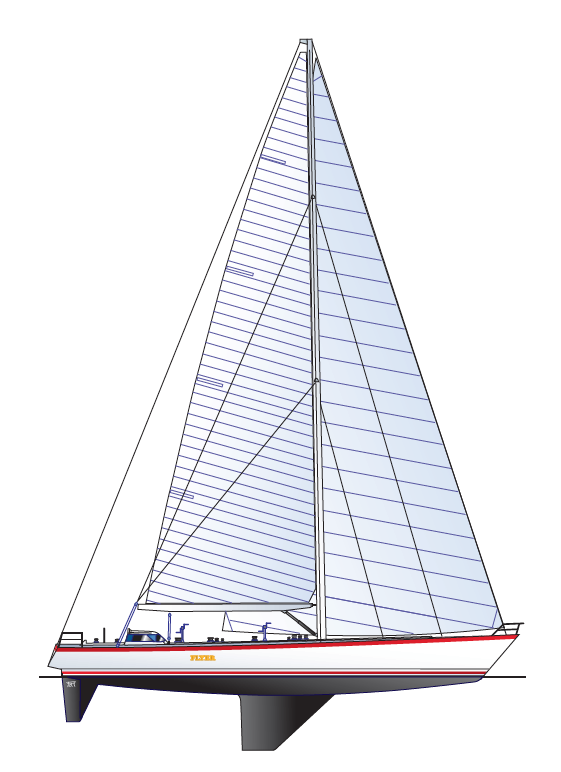
Pour l’édition 1977-78, l’allemand Cornelis van Rietschoten demande au cabinet Sparkman & Stephens de lui concevoir un vainqueur, de 65 pieds, mais avec une plus grande longueur à la flottaison, Flyer. Construit en aluminium par le chantier Huisman, le résultat s’avère redoutable. Il s’impose devant deux autres plans S & S, le Swan 65 Kind’s Legend et Traité de Rome, également construit chez Huisman.


1977 Flyer

En 1981, la Whitbread compte 29 partants, provenant de 14 nations. Si les plans S & S dominent, avec 6 concurrents, German Frers a quatre voiliers dont Flyer II de Cornelis van Rietschoten, de 23,16 mètres, qui a précisé sur sa commande qu’il désirait arriver le premier à chaque étape, ce qu’il réussit à faire. Charles Heidsieck III, un plan Vaton, à Alain Gabbay, arrive second. André Vian le suit avec son Kriter XI, un Frers de 19,00 mètres. Le quatrième, Disque d’Or III à Pierre Fehlman, est dû au crayon de Bruce Farr, spécialiste des voiliers qui surfent et planent volontiers, mais le bateau s’avère un peu chargé pour la circonstance.


1982 Flyer

Quatre ans plus tard, la Whitbread repart avec 15 concurrents, L’Esprit d’Équipe, un plan Briand de 17,60 mètres, qui courrait l’édition précédente sous le nom de 33 Export, l’emporte en temps compensé. Avec un déplacement léger et un gréement fractionné, équipage réduit, Lionel Péan s’impose devant la montée en puissance des plans de Bruce Farr, dont UBS Swiitzerland qui révolutionne l’architecture des Maxi. Le cabinet allemand Judel /Vrolijk fait son entrée en scène avec Phillips Innovator qui arrive second.

1985-86 L'esprit d'Equipe


En 1989, le cabinet Farr Yacht Design domine la course, avec les trois premières places, Peter Blake sur Steinlager 2, Grant Dalton sur Fisher & Paykel NZ et Pierre Fehlman sur Merit. Alain Gabbay arrive sixième avec un déplacement léger Charles Jourdan de 21,90 mètres, dessiné par Guy Ribadeau.

1989-90 Steinlager 2


Pour sa sixième édition, la Whitbread innove et introduit les W60, au milieu de 5 Maxi, dont trois plans Farr en tête. D’une longueur de 19,50 mètres pour un bau de 5,25 mètres et un tirant d’eau de 3,25, le tirant d’air est de 26 mètres et le déplacement limité à 13,500 kg. Bruce Farr dessine 7 des 10 concurrents qui peuvent avoir des ballasts d’eau et ont une quille fixe. Ross Field remporte le trophée dans sa classe sur Yamaha.


Le plan de forme de New Zealand Endeavour montre bien l’interprétation de la jauge IOR de Bruce Farr, avec des formes extrêmement tendues sur l’avant, une énorme bosse de jauge au couple numéro 6, où les lignes d’eau convergent et un arrière fuyant, avec un fond pratiquement plat et des flancs évasés. 

1993-94 Yamaha


1993-94 New Zealand Endeavour 

THE EVOLUTION OF THE HULL DESIGNS OF THE WITHBREAD YACHTS, SINCE 1974 TO THE OCEAN RACE 2023

PART ONE

From the 1970s Maxi to the first W60


From the first Whitbread Round the World Race, in 1974-75, the diversity of the competitors' designs has set the tone for this saga. 

©Francois Chevalier 

The first French competitor, André Vian's Grand Louis, finished 3rd, with a Dominique Presles design, built in polyester and polyurethane foam sandwich, fitted with a schooner rig with a length of 18.40 meters by 4.60 meters at beam. 

1974 Sayula II


The 4th, Jack Grout's Kriter, was 20.27 meters long, fitted as a ketch, and built out of molded wood according to Georges Auzépy-Brenneur’s the drawings.

Pen Duick VI Sections

These two yachts designed for this adventure, looked like comfortable charter boats, quite different from the design of Pen Duick VI, 22.25 meters long, built in aluminum, with shapes derived from the last creations of André Mauric's IOR racers, with a ballast in depleted uranium.

1974 Sayula II Lines

However, it was a great classic, the Sayula II series Swan 65, designed by Sparkman & Stephens, who had been leading the race since the 1930s. With a generously sized beam, shapes that provided stiffness and slenderness, and very well balanced, the yacht kept its speed in heavy seas. 

For the 1977-78 edition, the German Cornelis van Rietschoten asked Sparkman & Stephens to design a 65-foot winner with a longer waterline length, Flyer. Built in aluminum by the Huisman yard, the result was impressive. She won ahead of two other S & S designs, the Swan 65 Kind's Legend and Traité de Rome, also built at Huisman.

1977 Flyer

The 1981 Whitbread counted 29 starters, coming from 14 nations. While the S & S designs dominated, with 6 competitors, German Frers had four yachts, including the 23.16 meters long Cornelis van Rietschoten's Flyer II, who specified in his order that he wished to arrive first at each leg, which he managed to do. Alain Gabbay's Charles Heidsieck III, arrived second. André Vian followed him with his Kriter XI, a 19 meter Frers. The fourth yacht, Pierre Fehlman's Disque d'Or III, a Bruce Farr’s design, who was a specialist in surfing yachts, was a bit heavy for the occasion.

1982 Flyer

Four years later, the Whitbread was sailed again with 15 participants. L'Esprit d'Équipe, a 17.60 meter Philippe Briand's design, which had raced the previous edition under the name 33 Export, won on corrected time. With a light displacement and a fractional rig and reduced crew, Lionel Péan went first ahead of the rising strength of Bruce Farr's designs, including UBS Switzerland which revolutionized the design of Maxi yachts. The German company Judel/Vrolijk made its debut with Phillips Innovator, which finished second.
1985-86 L'esprit d'Equipe


In 1989, Farr Yacht Design office was the leading firm taking the three first positions, Peter Blake on Steinlager 2, Grant Dalton with Fisher & Paykel NZ and Pierre Fehlman aboard Merit. Alain Gabbay arrived in 6th position with the Guy Ribadeau's design Charles Jourdan, a light displacement of 21.90 meters.
1989-90 Steinlager 2


For its sixth edition, the Whitbread broke new ground and launched the W60s, in the midst of five Maxi yachts, including three Farr designs in the leading position. With a length of 19.50 m for a beam of 5.25 m and a draft of 3.25 m, the air draft was 26 m and the displacement limited to 13,500 kg. Bruce Farr designed 7 of the 10 racers that could be filled with water ballast and had a fixed keel. Ross Field won the trophy in her class aboard Yamaha.

The New Zealand Endeavour's design shows Bruce Farr's understanding of the IOR rule, with extremely stretched bow shapes, a huge measurement bulge at frame number 6, where the water lines converge, and with a tapering stern, with a virtually flat bottom and flared sides. 
1993-94 Yamaha


1993-94 New Zealand Endeavour 

lundi 26 décembre 2022

SYDNEY HOBART YACHT RACE 2022


THE FOUR 100 FOOT IN HOBART or THE BATTLE OF GIANTS

LES QUATRE 100 PIEDS À HOBART ou LA BATAILLE DES GEANT

Four 100 ft (30.48 m) maxis, among the 120 boats entered, tookthe start of the seventy-seventh Rolex Sydney Hobart race on December 26.


Quatre maxi de cent pieds (30,48 m) parmi les 120 voiliers inscrits, ont pris le départ de la soixante-dix-septième Rolex Sydney Hobart en Australie le 26 décembre.


1 - ANDOO COMANCHE, ex-COMANCHE

Andoo Comanche has held the record for the event since 2017 in 1 day, 9 hours, 15 minutes and 24 seconds. He has crossed the line three times as the winner, his favorite pace is downwind.

Andoo Comanche détient le record de l’épreuve depuis 2017 en 1 jour, 9 heures, 15 minutes et 24 secondes. Il a franchit la ligne trois fois en vainqueur, son allure préférée est le portant.

ANDOO COMANCHE

2 - LawConnect, ex-INFOTRACK, ex-PERPETUAL LOYAL, ex-RAMBLER 100, ex-SPEEDBOAT, ex-VIRGINE MONEY, ex-SPEEDBOAT

Perpetual Loyal finished first in 2016, clocking a record on the course by 5 hours less than the previous one, then held by Wild Oats XI.

Perpetual Loyal est arrivé en tête en 2016, établissant un record sur le parcours de 5 heures de moins que le précédent, détenu alors par Wild Oats XI.


LawConnect


3 - WILD OATS XI

Since 2005, Wild Oats XI has set the record for the most victories in Hobart, with nine "Lines Honors", two of which were time records, and an IRC win in 2012.

Depuis 2005, Wild Oats XI détient le record du nombre de victoires à Hobart, soit neuf “Lines Honors’’, dont deux temps records, et une victoire en IRC, en 2012.

WILD OATS XI


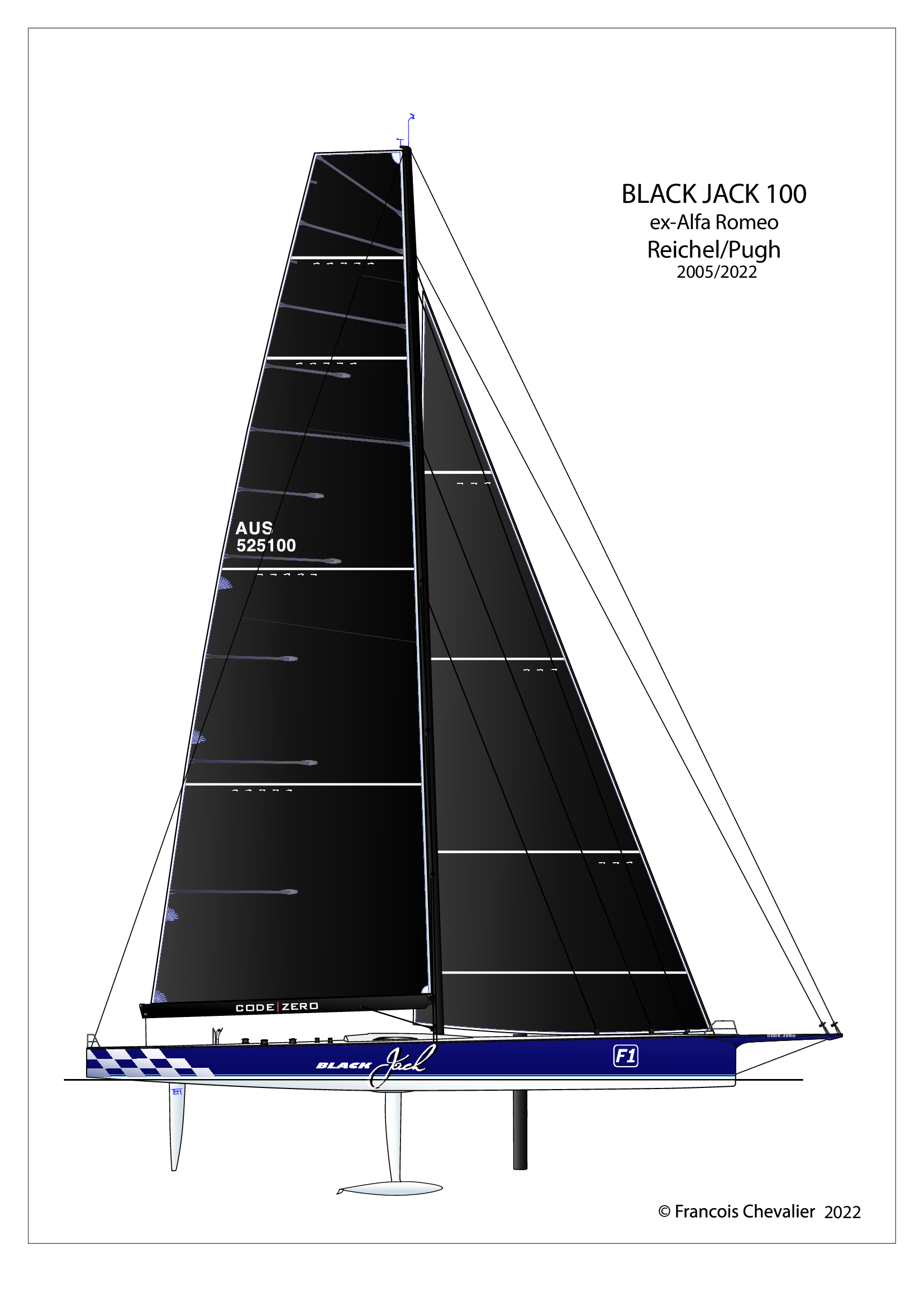
4 - BLACK JACK 100, ex-ESIMIT EUROPA II, ex-ALFA ROMEO II, ex-SHOCKWAVE

In 2009, Alfa Romeo II came out on top. Extensively modified by the original designer and yard on the aft quarter in 2019, Black Jack 100 finished first last year, in 2021.   

En 2009, Alfa Romeo II était arrivé en tête. Modifié profondément par l’architecte et le chantier d’origine  sur la moitié arrière en 2019, Black Jack 100 est arrivé le premier l’année dernière, en 2021.  

BLACK JACK 100